


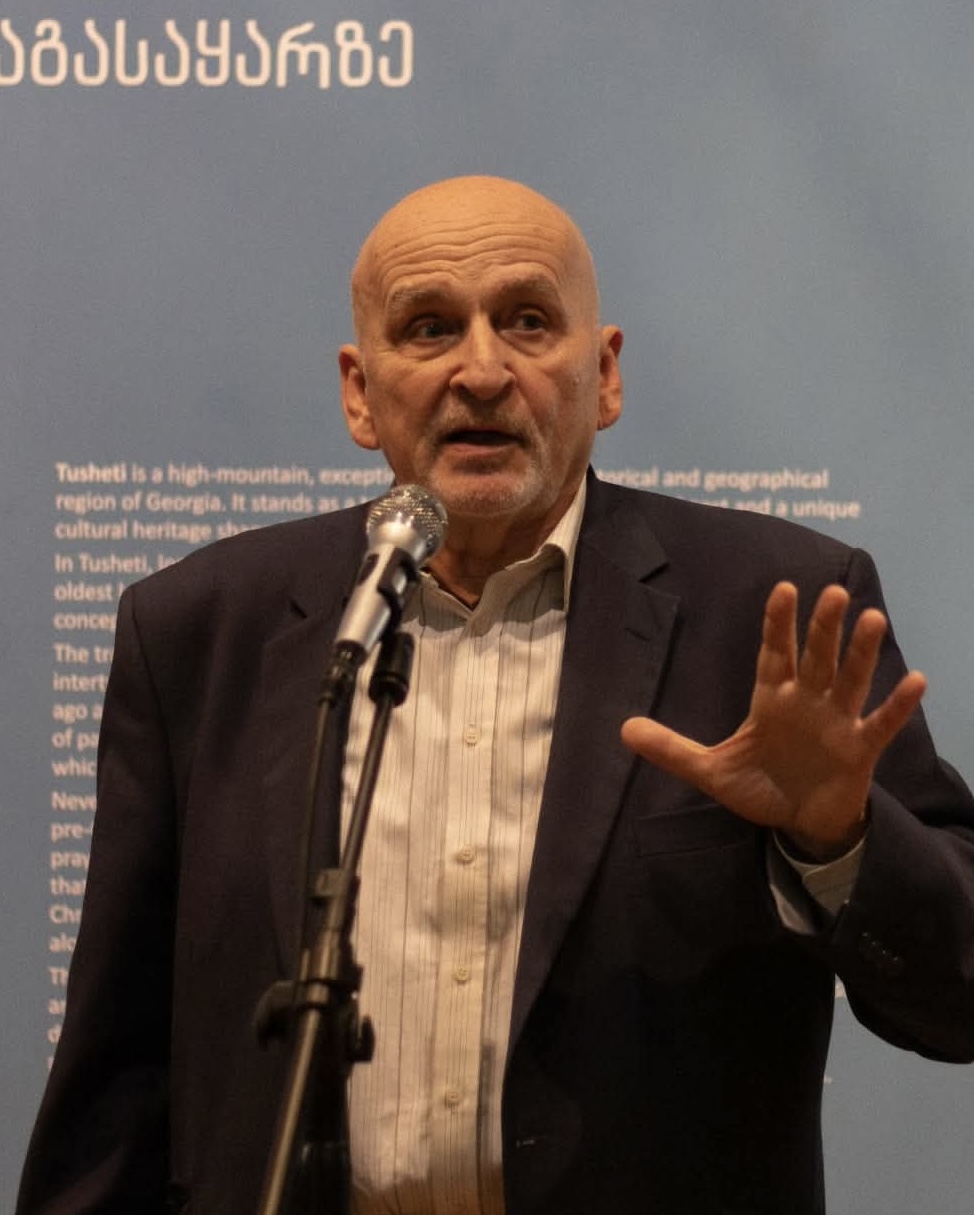
Nodar Bakhtadze is a Doctor of Historical Sciences, archaeologist, and historian of architecture. He was born in 1953. He graduated from the Georgian Technical University, specializing in architectural theory. From 1978 to 1980, he completed postgraduate studies in art history and archaeology at Ivane Javakhishvili Tbilisi State University. Between 1978 and 1989, he worked at the Simon Janashia Georgian National Museum, initially as a junior research fellow and later as a senior research fellow, and served as the head of several archaeological expeditions.
In 1989, he defended his Candidate of Sciences (PhD-equivalent) dissertation entitled “Rock-Cut Monuments of Kvemo Kartli.” In 2004, he defended his Doctor of Historical Sciences dissertation, “The Genesis and Developmental Paths of Rock-Cut Architecture in Georgia.”
From 1995 to 2005, he was affiliated with Sulkhan-Saba Orbeliani Tbilisi State University, where he served as a Professor of Art History, first as an assistant professor and subsequently as a full professor. Since 2010, he has been a Professor of Archaeology at Ilia State University. He currently serves as the Head of the Archaeology Programs at this university. Since 2004, he has also held the position of Principal Research Fellow at the Georgian National Museum.
Between 1980 and 2025, Nodar Bakhtadze led numerous archaeological expeditions in various regions of Georgia. The archaeological investigation of architectural monuments from the Late Antique and Medieval periods across the Caucasus constitutes the principal focus of his scholarly research. He is the author of eight monographs and more than 120 scholarly publications. Nodar Bakhtadze is a participant in numerous international scientific conferences and congresses, a member of the editorial boards of several scientific journals.